> For the complete documentation index, see [llms.txt](https://obvious-game.gitbook.io/soap/llms.txt). Markdown versions of documentation pages are available by appending `.md` to page URLs; this page is available as [Markdown](https://obvious-game.gitbook.io/soap/scene-documentation/5_scriptablesaves/save-data.md).
# Save Data
5\_ScriptableSave
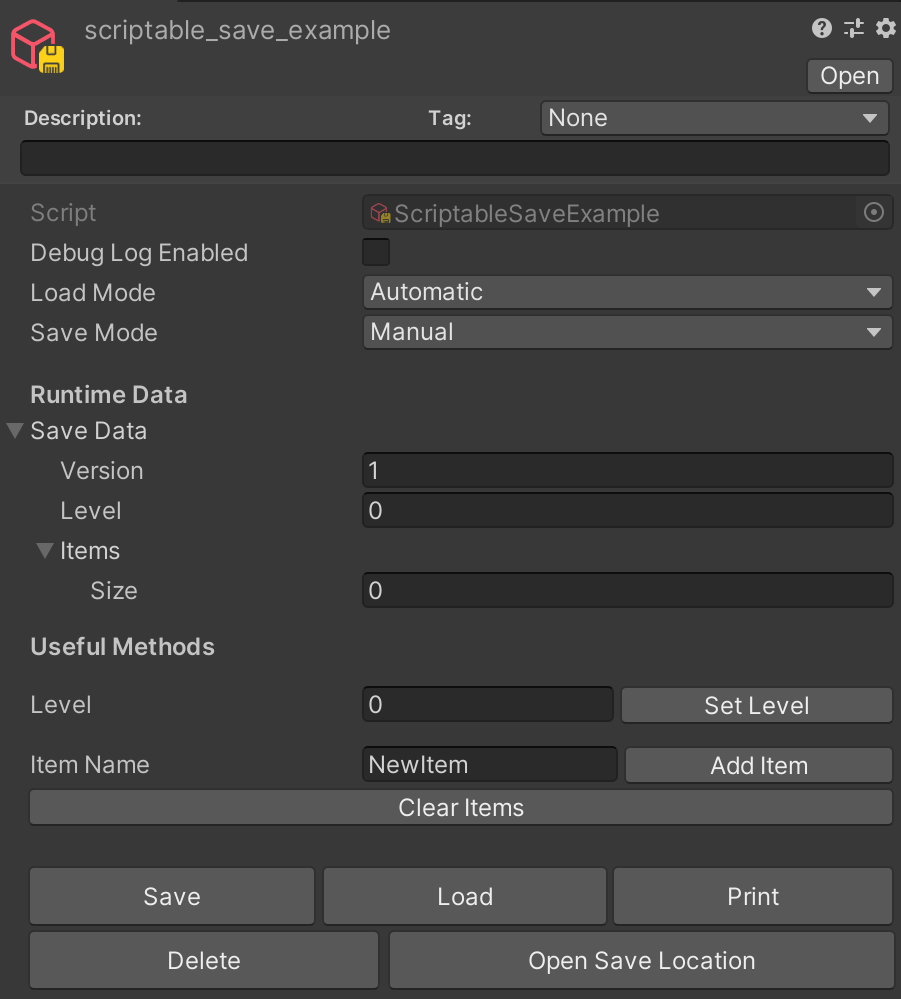
In the project window, locate the scriptable\_save\_example and select it.
 There is a lot to see, but actually this is a new empty save file. Let's quickly check in the code what data we are actually saving to disk. Open the script ScriptableSaveExample.cs.
```csharp
[Serializable]
public class SaveData
{
public int Version = 1;
public int Level = 0;
public List
There is a lot to see, but actually this is a new empty save file. Let's quickly check in the code what data we are actually saving to disk. Open the script ScriptableSaveExample.cs.
```csharp
[Serializable]
public class SaveData
{
public int Version = 1;
public int Level = 0;
public List- Items = new List
- ();
}
[Serializable]
public class Item
{
public string Id;
public string Name;
public Item(string name)
{
Id = Guid.NewGuid().ToString();
Name = name;
}
}
```
At the top of the file, we can see that our save data has a version number, a level, and a list of Items (which are defined just below). Note that these classes are marked \[Serializable] in order to be able to convert them to JSON.
The SaveData class is the class you will customize for your game. Each game is different, so I've kept this example simple.